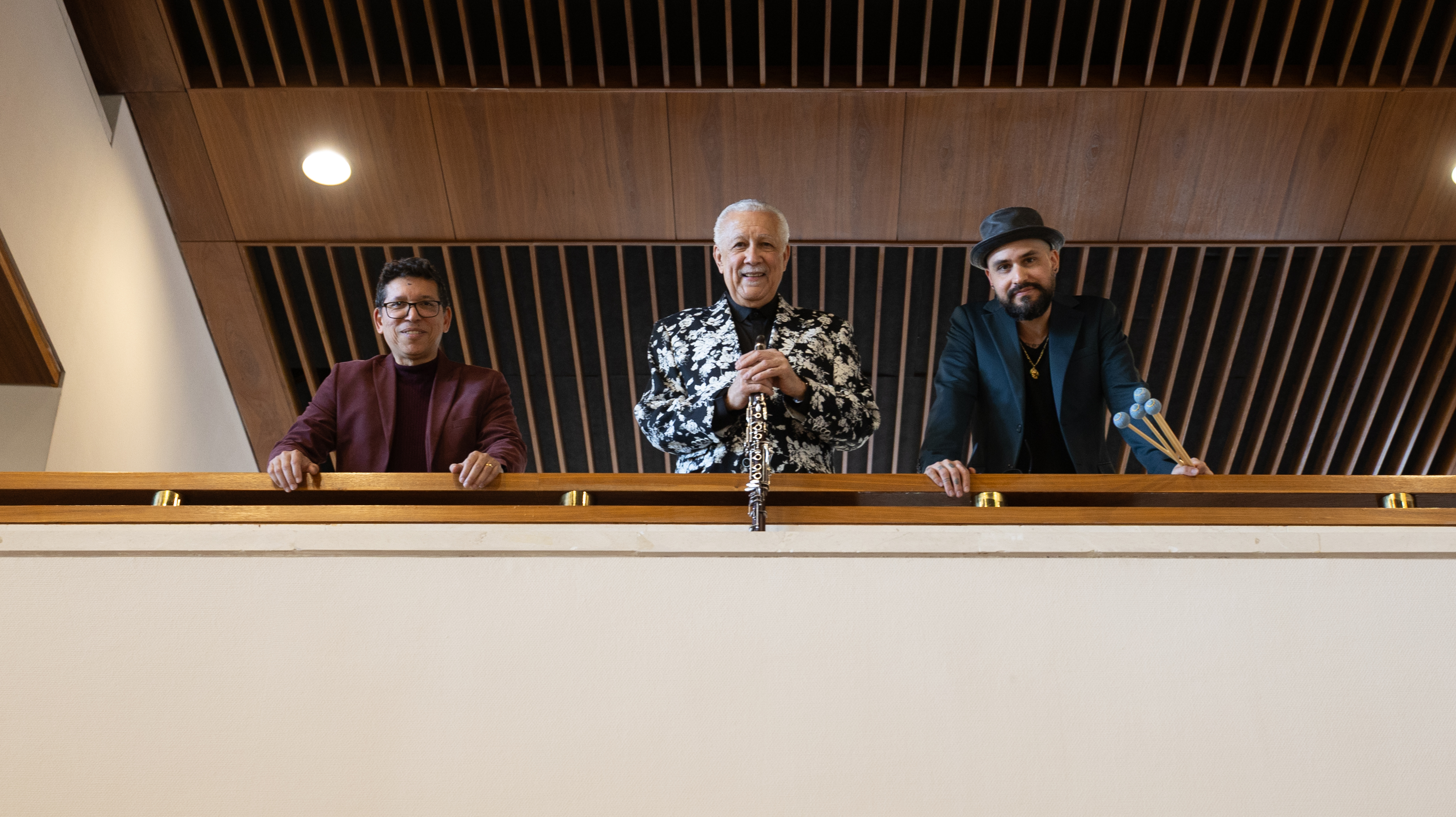
(English Version)
Paquito D’Rivera, considered one of the world’s finest saxophonists and clarinetists, has received no fewer than 18 Grammy and Latin Grammy Awards combined (7 Grammy and 11 Latin Grammy) throughout his extensive musical career. He is the author of a vast body of work that reveals his broad and eclectic musical interests, ranging from Afro-Cuban rhythms and melodies, including influences gathered during his many travels, to his musical origins.
The jazz musician, arranger, and composer is passionate about both jazz and classical music and has become a leading figure in Afro-Cuban music and the standards of modern Latin jazz.
He was born in Cuba, where he began his career as a child prodigy, playing both clarinet and saxophone with the Cuban National Symphony Orchestra. The son of Cuban saxophonist and orchestra leader Tito D'Rivera, Paquito began studying music at just five years old and by seven he was already performing in front of the public and had signed a contract with the famous musical instrument manufacturer 'Selmer'
He was a founding member and co-director of the innovative musical group ‘Irakere’, alongside his close friend Chucho Valdés, a group that stood out for its explosive blend of jazz, rock, classical music, and traditional Cuban music.
Paquito D’Rivera is a master of the clarinet, alto saxophone, and soprano saxophone. He has received numerous awards for his contributions to Latin jazz and as a composer of classical music.
Paquito D’Rivera defies categorization. He has won a combined 18 Grammy and Latin Grammy Awards (7 Grammy and 11 Latin Grammy). He is celebrated for both his artistry in Latin jazz and his achievements as a classical composer.
Born in Havana, Cuba, he performed at the age of ten with the orchestra of the National Theater of Cuba, studied at the Havana Conservatory of Music, and at 17 became a featured soloist with the National Symphony Orchestra. As a founding member of the Cuban Orchestra of Modern Music, he led the group for two years while simultaneously playing clarinet and saxophone with the National Symphony Orchestra of Cuba. He went on to present several works by notable Cuban composers with the same orchestra.
In addition, he was a founding member and co-director of the groundbreaking band Irakere. With its explosive blend of jazz, rock, classical, and traditional Cuban music unlike anything heard before, Irakere toured throughout the Americas and Europe, earning numerous Grammy nominations (1979, 1980) and a Grammy Award (1979). His extensive recordings include more than 30 solo albums. In 1988, he founded The United Nation Orchestra, a 15-member band organized by Dizzy Gillespie to showcase the fusion of Latin and Caribbean influences with jazz. D’Rivera continues to appear as a guest conductor. The United Nation Orchestra won a Grammy in 1991, the same year D’Rivera received a Carnegie Hall Lifetime Achievement Award for his contributions to Latin music. On the other hand, D’Rivera’s highly acclaimed bands, the Chamber Jazz Ensemble, the Paquito D’Rivera Big Band, and the Paquito D’Rivera Quintet, are in high demand all over the world.
While D’Rivera’s discography reflects a dedication to and enthusiasm for jazz, bebop, and Latin music, his contributions to classical music are equally impressive. These include solo performances with the London Philharmonic Orchestra, the London Symphony Orchestra, the Warsaw Philharmonic Orchestra, the National Symphony Orchestra, the Baltimore Symphony Orchestra, the Florida Symphony Orchestra, and the Brooklyn Philharmonic. He has also performed with the Puerto Rico Symphony Orchestra, the Costa Rica National Symphony Orchestra, the Simón Bolívar Symphony Orchestra, the Bronx Arts Ensemble, and the St. Luke’s Chamber Orchestra, among others. Driven by his passion for giving greater prominence to the Latin repertoire, D’Rivera has successfully created, championed, and promoted all kinds of classical compositions, including his three chamber works recorded live in concert with the distinguished cellist Yo-Yo Ma in September 2003. The chamber work, Merengue Live at Zankel Hall, was released by Sony Records, and D’Rivera earned his seventh Grammy Award for Best Instrumental Composition in 2004. D’Rivera has quickly gained a reputation as a successful composer. His prestigious music label, Boosey and Hawkes, is the exclusive record label for D’Rivera’s compositions.
More recent recognition of his compositional abilities came with the award of the John Simon Guggenheim Fellowship in 2007 for musical composition and his appointment as composer-in-residence at the Caramoor Music and Arts Center with the Orchestra of St. Luke for the 2007–2008 term. As part of Caramoor's Latin American music initiative, Sonidos Latinos, D'Rivera's new concerto for double bass and clarinet/saxophone, Conversations with Cachao, pays homage to the legendary Cuban bassist Israel "Cachao" López. D'Rivera's works also often reveal his broad and eclectic musical interests, ranging from Afro-Cuban rhythms and melodies—including influences encountered on his many travels—to his musical origins. The inspiration for another of his new compositions, The Cape Cod Files (2009), comes from sources as diverse as Benny Goodman's intro to Eubie Blake's folk song "Memories of You," the Argentine milonga, improvisations on the music of Cuban composer Ernesto Lecuona, and American boogie-woogie. His numerous commissions include jazz compositions for Lincoln Center, the Library of Congress, the National Symphony Orchestra, the Rotterdam Philharmonic, the Turtle Island String Quartet, the Ying String Quartet, the International Double Reed Society, Sicacusa University, Montreal’s Gerald Danovich Saxophone Quartet, and the Grant Park Music Festival.
Another commission came through the band Opus 21 and their interest in building bridges between audiences from diverse backgrounds. Dedicated to 21st-century musical work and art, Opus 21 commissioned “The Chaser” and premiered it in May 2006. In 2005, Imani Winds, a wind quintet, committed to exploring the diverse traditions of world music, expanding into the wind quintet repertoire, and commissioned “Kites.” This work embodied freedom and the vision that such freedom and independence are grounded in culture and music. Just as a kite flies freely, its path remains tied to the earth—its base—by the string.
D’Rivera is the author of two books: My Sax Life, published by Northwestern University Press, and a novel, Oh, La Habana, published by MT Editores, Barcelona. He was awarded the NEA Jazz Masters Award in 2005 and the National Medal of Arts in 2005, as well as the Living Jazz Legend Award from The Kennedy Center in 2007. His many other honors include honorary doctorates in Music (from Berklee College of Music in Boston and the University of Pennsylvania) and the Clarinetist of the Year Award from the Jazz Journalists Association in 2004 and 2006. In 2008, D’Rivera received the Association for Jazz Education Present Award and the Frankfurter Musikpreis in Germany. He also received the National Arts Club Medal of Honor in 2009. In 2010, he was named a Nelson A. Rockefeller Honoree and received the Spelman College African-American Classical Music Award.
He received his tenth and eleventh Grammy Awards in 2011 for Panamericana Suite as Best Latin Album and Best Contemporary Classical Composition, adding to his previous Grammy Awards for Riberas (Best Classical Recording 2005) and Funk Tango (Best Latin Jazz Album 2008). D’Rivera is the first artist to win Latin Grammys in both the classical and Latin jazz categories—for Stravinsky’s The Soldier’s Tale (L’Histoire du Soldat) (2003) and Brazilian Dreams (2002) with New York Voices. He has served as artistic director for the jazz program of the New Jersey Chamber Music Society, the DC Jazz Festival in Washington, D.C., and Jazz Patagonia in Chile, and continues as artistic director of the renowned Punta del Este International Jazz Festival in Uruguay.
In 1999, to celebrate its 500th anniversary, the University of Alcalá de Henares presented D’Rivera with a special award recognizing his contribution to the arts, his personal qualities, and his advocacy for the rights and freedoms of artists worldwide. The National Endowment for the Arts states on its website that he “has become an accomplished multinational ambassador, creating and promoting an intercultural musical landscape that moves effortlessly between jazz, Latin music, and Mozart”.
PAQUITO D’RIVERA QUINTETO:
Paquito D’Rivera
Pepe Rivero (piano)
Reinier Elizarde “El Negro” (contrabajo)
Georvis Pico Milian (batería)
Sebastián Laverde (vibráfono)
PAQUITO D’RIVERA TRÍO:
Paquito D’Rivera
Pepe Rivero (piano)
Sebastián Laverde (vibráfono)
CUBA EN LA DISTANCIA:
Paquito D’Rivera + Carlos Cano + Hernán Milla
(Versión español)
Paquito D’Rivera desafía la categorización. Ha ganado 18 premios Grammy y Latin Grammy combinados (7 Grammy y 11 Latin Grammy). Es célebre tanto por su arte en el jazz latino como por sus logros como compositor clásico.
Nacido en La Habana, Cuba, actuó a la edad de diez años con la orquesta del Teatro Nacional de Cuba, estudió en el Conservatorio de Música de La Habana y con 17 se convirtió en un solista destacado con la Orquesta Sinfónica Nacional. Como miembro fundador de la Orquesta Cubana de Música Moderna, dirigió el grupo durante dos años al mismo tiempo que tocaba el clarinete y el saxofón con la Orquesta Sinfónica Nacional de Cuba. Con el tiempo pasó a presentar varios trabajos de notables compositores cubanos con la misma orquesta.
Además, fue un miembro fundador y codirector de la innovadora banda de música Irakere. Con su explosiva mezcla de jazz, rock, clásica y música tradicional cubana nunca antes escuchada, Irakere fue de gira por toda América y Europa, ganando numerosas nominaciones de los Grammy (1979, 1980) y un premio Grammy (1979). Sus múltiples grabaciones incluyen más de 30 álbumes en solitario. En 1988, fundó The United Nation Orchestra, una banda de 15 miembros organizada por Dizzy Gillespie para presentar la fusión de influencias latinas y caribeñas con el jazz. D’Rivera continúa apareciendo como un director invitado. The United Nation Orchestra ganó un Grammy en 1991, el mismo año que D’Rivera recibió un premio por los éxitos de una vida de Carnegie Hall por sus contribuciones a la música latina. Por otro lado, las grandes aclamadas bandas de D’Rivera, the Chamber Jazz Ensemble, la Paquito D’Rivera Big Band, y Paquito D’Rivera Quintet, están muy solicitadas por todo el mundo.
Al tiempo que la discografía de D’Rivera refleja una dedicación y entusiasmo por el jazz, el bebop y la música latina, sus contribuciones a la música clásica son también impresionantes. Incluyen actuaciones solistas con la filarmónica de Londres, la London Symphony Ochestra, la Warsaw Philharmonic Orchestra, la Orquesta Sinfónica Nacional, la Baltimore Symphony, la Orquesta Sinfónica de Florida y la filarmónica de Brooklyn. También ha actuado con la Orquesta Sinfónica de Puerto Rico, la Sinfónica Nacional de Costa Rica, la Orquesta Sinfónica Simón Bolívar, la Bronx Arts Ensemble, y la St. Luke’s Chamber Orchestra, entre otras. En su pasión por darle al repertorio latino mayor relevancia, D’Rivera ha creado, defendido y promovido con éxito toda clase de composiciones clásicas, incluyendo sus tres composiciones de cámara grabadas en un concierto en vivo con el distinguido violonchelista Yo-Yo Ma en septiembre de 2003. El trabajo de cámara Merengue en directo en el Zankel Hall fue publicado por Sony Records y D’Rivera obtuvo su séptimo Grammy por Mejor Composición Instrumental en 2004. D’Rivera ha ganado rápidamente una reputación como un compositor de éxito. Su prestigioso sello de música Boosey and Hawkes es la discográfica exclusiva de las composiciones de D’Rivera.
Un reconocimiento más reciente de sus habilidades para la composición vino con el premio de la John Simon Guggenheim Fellowship en 2007 por composición musical y el nombramiento de 2007-2008 a compositor en residencia del centro de Música y Artes de Caramoor con la Orquesta de St. Luke. Como parte de la iniciativa musical Latinoamericana de Caramoor, Sonidos Latinos, el nuevo concerto de D’Rivera para doble bajo y clarinete/saxofón, Conversations with Cachao, rinde homenaje al legendario bajista cubano Israel “Cachao” López. Los trabajos de D’Rivera también revelan a menudo sus amplios y eclécticos intereses musicales, que van desde los ritmos y melodías afro-cubanos—incluyendo influencias encontradas en sus múltiples viajes—hasta sus orígenes musicales. La inspiración para otra de sus nuevas composiciones, The Cape Cod Files (2009), viene de tan dispares fuentes como la intro de Benny Goodman de la canción popular “Memories of You” de Eubie Blake, la milonga argentina, improvisaciones de la música del compositor cubano Ernesto Lecuona y el boogie-woogie norteamericano. Sus numerosos encargos incluyen composiciones de jazz en el Lincoln Center, la Biblioteca del Congreso, la Orquesta Sinfónica Nacional, la Filarmónica de Rotterdam, el Turtle Island String Quartet, Ying String Quartet y la International Double Reed Society, la Universidad de Sicacusa, el Montreal’s Gerald Danovich Saxophone Quartet y el Grant Park Music Festival.
Otro encargo vino a través de la banda Opus 21 y su interés en tender puentes entre audiencias de diferentes orígenes. Dedicado al trabajo y el arte musical del siglo XXI, Opus 21 encargó “The Chaser” y lo presentó en mayo del 2006. En 2005, Imani Winds, un quinteto de viento, se comprometió a la exploración de las diversas tradiciones de las músicas del mundo, ampliando a la literatura del quinteto de viento, y encargó “Kites”. Este trabajo personificó la libertad y la visión que esa libertad e independencia tienen su fundamento en la cultura y la música. Tal y como la cometa vuela libremente, su camino continúa atado a la tierra—su base—por la cuerda.
D’Rivera es el autor de dos libros: My Sax Life, publicado por la Northwestern University Press y una novela Oh, La Habana, publicado por MT Editores, Barcelona. Fue galardonado con el premio NEA Jazz Masters en 2005 y con la National Medal of the Arts en 2005, además del premio Living Jazz Legend de The Kennedy Center en 2007. Sus otros múltiples honores incluyen el doctorado Honoris Causa en Música (de la facultad de Música Berklee en Boston y en la Universidad de Pensilvania) y el premio al Clarinetista del Año por la Jazz Journalist Association en 2004 y en 2006. En 2008, D’Rivera recibió el premio de la Association for Jazz Education Present y el Frankfurter Musikpreis en Alemania. También recibió la Medalla de Honor del Club de Artes Nacional en 2009. En 2010, fue nombrado como Nelson A Rockefeller Honoree y le dieron el premio de la Música Clásica Afro-Americana del Spelman College. Recibió su décimo y décimo primer premios Grammy en 2011 por Panamericana Suite como Mejor Álbum Latino y Mejor Composición Clásica Contemporánea, sumándolo a sus anteriores premios Grammy por Riberas (Mejor Grabación Clásica 2005) y Funk Tango (Mejor Álbum de Jazz Latino 2008). D’Rivera es el primer artista en ganar Grammys latinos tanto en las categorías de clásica como en jazz latino—por Historia del Soldado (L’Histoire du Soldat) de Stravinsky (2003) y Brazilian Dreams (2002) con New York Voices. Ha atendido como director artístico al programa de jazz de la New Jersey Chamber Music Society, del DC Jazz Festival en Washington DC, y al Jazz Patagonia de Chile, y continúa también como director artístico del famoso festival de primera categoría Festival Internacional de Jazz de Punta del Este en Uruguay.
En 1999, y como celebración de sus 500 años de historia, la Universidad de Alcalá de Henares hizo entrega a D’Rivera del premio especial que reconoce su contribución a las artes, sus cualidades humanas y su defensa por los derechos y las libertades de los artistas en todo el mundo. El National Endowment for the Arts en su página web afirma “se ha convertido en un embajador consumado multinacional, creando y promoviendo una interculturalidad de música que se mueve sin esfuerzo entre el jazz, la música latina y Mozart.”